
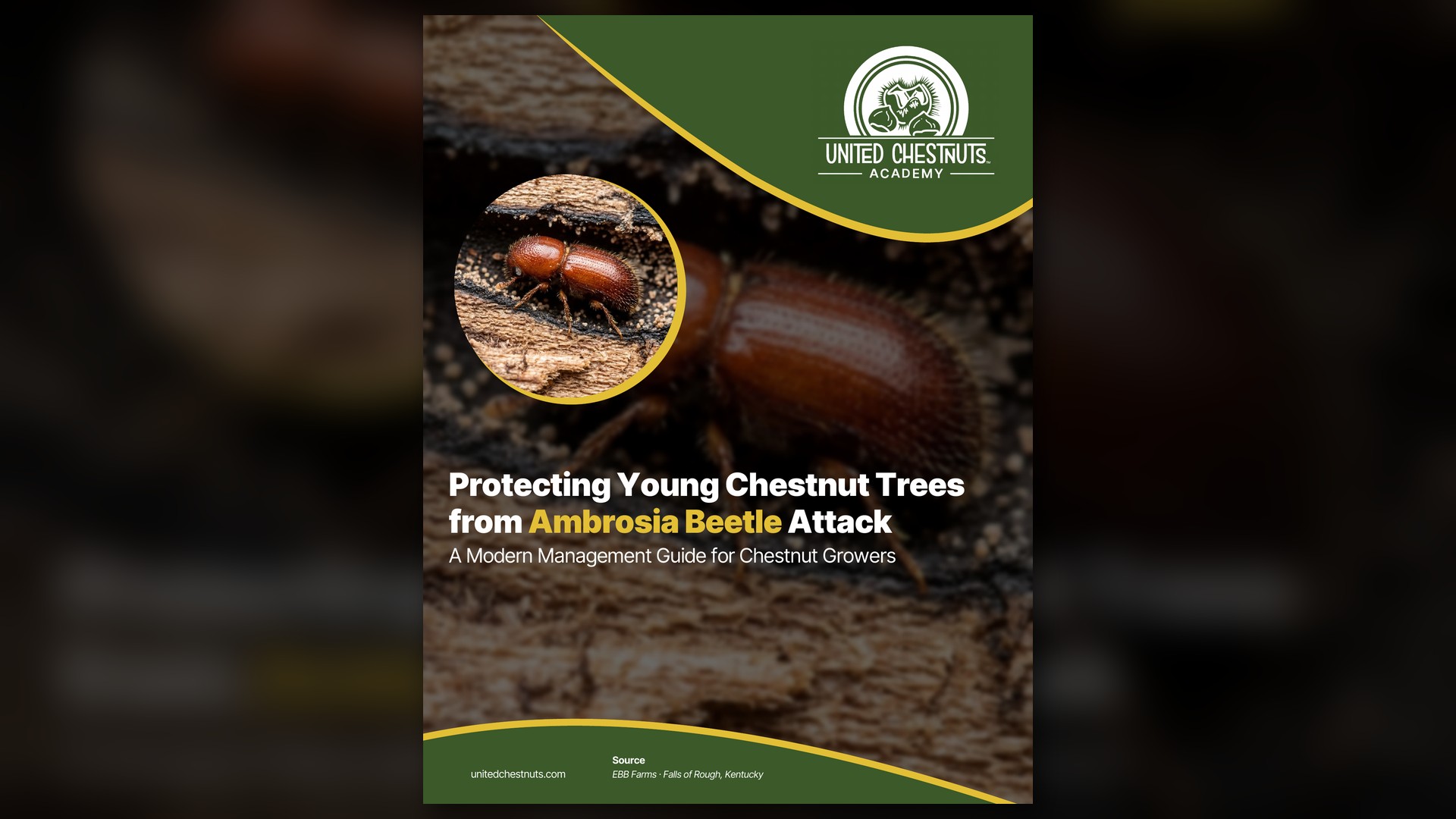
Protecting Young Chestnut Trees from Ambrosia Beetles
$15.00
Protect your orchard investment with the 2026 Ambrosia Beetle Chestnut Management Guide. This 21-page digital playbook provides growers in the Southeast and Midwest with a research-backed strategy for defending young trees (1/2 to 4 inches in diameter) against lethal wood-boring attacks.
The first few years after planting are when young chestnuts face the most risk from wood-boring pests. That’s why good ambrosia beetle chestnut management matters so much early on.
The Asian ambrosia beetle is about the size of a grain of rice. It’s also called the granulate ambrosia beetle. It goes after trunks between ½ and 4 inches across.
These beetles don’t eat the wood. Instead, they grow a fungus inside the trunk. As a result, the fungus blocks the flow of water and nutrients. This happens right when your trees push new spring growth and need those resources most.
This 21-page guide covers the biology, monitoring, and management steps that protect young chestnuts. In other words, it helps your trees reach the size where their own defenses take over.
What You’ll Learn About Ambrosia Beetle Chestnut Management
-
Why beetles target stressed trees, and why young chestnuts stand out to them.
-
How temperature drives spring flights, so you can predict when your orchard is at risk.
-
How to set up traps and run field checks.
-
Which farm practices lower risk, such as drainage and irrigation timing.
-
Spray options and timing, plus ways to limit harm to other insects.
-
What to do when you find an infested tree, and how to stop the spread.
-
New approaches still in research trials, for example push-pull methods and biological controls.
What’s Inside
-
Flight timeline maps for the Southeast and Mid-Atlantic.
-
A 6-step action plan for managing beetles.
-
Research summaries from The American Chestnut Foundation, extension programs, and USDA trials.
-
Ways to reduce your use of broad-spectrum insecticides.
Why Chestnuts Need Their Own Plan
Chestnuts are different from other tree crops. For example, young chestnut plantings face challenges that standard orchard models don’t cover. Ambrosia beetles are one of them. In fact, beetle pressure is especially strong in the Southeast, Southwest, and lower Midwest. There, it lines up with spring planting stress.
However, managing this pest isn’t about fear. Instead, it’s about making smart choices while your trees build roots and structure. After all, those early years set up decades of harvests.
Who It’s For
-
Growers starting new chestnut plantings.
-
Orchards in GA, AL, SC, TN, KY, NC, VA, TX, and MD.
-
Anyone with trees in the ½ to 4-inch range.
-
Farmers adding chestnuts to regenerative or agroforestry systems.
Format: PDF digital download, 21 pages.
So download the guide and protect your young chestnuts through their first years.